Emotional Residue: Why You Still Feel It After It's Over
Aug 13, 2026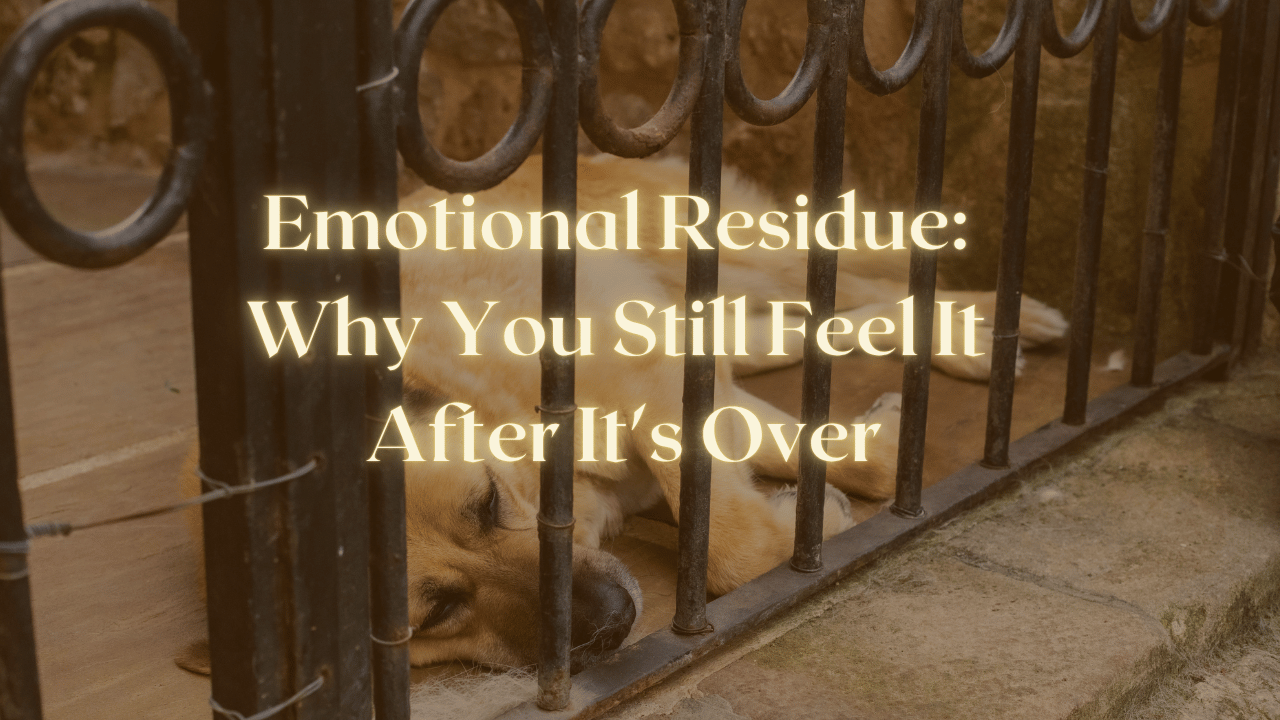
The conversation is over. The relationship ended, or the job ended, or the difficult afternoon simply finished. You left the room. And yet, days or weeks later, something in you is still in it. A knot in the chest that arrives on its own schedule. Shoulders that climb toward your ears in perfectly safe company. A kind day that reads, for no reason you can defend, slightly threatening.
This is emotional residue: the way a hard experience keeps living in the body after the mind has filed it under finished. It is one of the most common experiences sensitive people describe, and one of the least talked about, because it feels embarrassing to admit. You know better. You can explain exactly why the moment has no current claim on your life. It echoes anyway.
Here is the sentence this whole article rests on: knowing better is not the same as being free. Freedom is real work, it happens on the body's timeline rather than the mind's, and there are gentle, practical ways to help it along. That is what we will walk through.
Table of contents
- What is emotional residue?
- Why does my body still react when the situation is over?
- What does emotional residue feel like?
- Why do I judge myself for not being over it yet?
- How do you release emotional residue?
- When does residue need more support?
- Frequently asked questions
What is emotional residue?
Emotional residue is the lingering bodily and emotional imprint of an experience that has already ended. The event is over, but its echo keeps arriving: as tension, as vigilance, as a mood that colors everything, as a knot that returns at its own hours.
A useful way to see it clearly is to compare two kinds of echoes. Think of a moment you embarrassed yourself publicly. For many of us, that moment comes back for days, in the middle of folding laundry, and we laugh all over again, alone in the kitchen. That is an echo too. It costs nothing. It is proof that a moment can follow you out of a room and be harmless.
Now think of a moment someone hurt you. Same mechanism, a moment following you out of a room. Completely different bill. This echo arrives as a physical knot, and for a while it changes the color of everything you look at. A neutral silence reads like the pause before something bad. That difference, between the echo that entertains and the echo that occupies, is the difference between a memory and residue.
Residue is not weakness, and it is not a failure to move on. It is a nervous system doing exactly what nervous systems are built to do: remembering, in the body, what once hurt, so it can be avoided next time. If you feel things deeply, your system tends to record deeply too. The same depth that makes you perceptive makes the residue thicker. If that depth is new territory for you, our pillar guide to emotional regulation for highly sensitive people is the wider map this article sits inside.
Why does my body still react when the situation is over?
There is an image that explains this better than any theory.
When a caged animal is rescued, something strange and well documented often happens. The door opens, the field is wide, and the animal walks out, and then sleeps pressed against the fence. Not because it loves the fence. Because its body was formatted by the fence. The fence was the one constant in a world that hurt, and a nervous system does not update itself on the strength of good news.
Logic opens the cage. Logic does not relocate where the body has learned to sleep.
That is why you can leave the room and still be in it. The thinking part of you updates quickly: the relationship is over, the job is behind me, the conversation ended. The protective part of you updates slowly, through repeated experiences of safety, not through arguments. Until it updates, it keeps running the old program: brace, scan, guard.
This is also why you cannot reason the residue away, and why trying so hard to do so often backfires. The residue does not live in the part of you that arguments reach. It lives in the part that learned, once, that this is what rooms can do, and is not yet convinced the lesson has expired. Understanding this mechanism more deeply is the heart of nervous system regulation: safety is something the body relearns through experience, at its own pace.
What does emotional residue feel like?
Residue has a signature, and learning to read yours is the first practical skill. The body keeps honest books. Common entries in the ledger:
- A returning knot. Chest, throat, or stomach. It arrives unannounced, often triggered by something small that rhymes with the original hurt.
- Tension with a pattern. A jaw clenched along one line. Shoulders up near the ears without being asked, the same shoulders that drop on their own in rooms that feed you. If you want to test which rooms those are, the good room test was written for exactly that.
- Scanning. Checking a safe face for the turn. Listening to a warm voice for the edge. Rereading a friendly message for the sentence that is not there. Attention spent guarding a border where there is no war.
- Color change. For a while, the residue tints everything. Kind days read slightly threatening. Neutral pauses read like warnings. You are not imagining this; a vigilant system paints the world in the palette of the last danger.
- Startle and fatigue. Guard duty is expensive. Many people in a residue season feel inexplicably tired, because a part of their budget is being spent on a war that ended.
None of these mean something is wrong with you. They mean something happened to you, and your body took it seriously.
Why do I judge myself for not being over it yet?
Then comes the second charge, and this one we issue ourselves.
First we judge ourselves for having let the hurt happen at all: I should have seen it, I should have left sooner, I should have said something. Then we judge ourselves for taking too long to put it down: it has been weeks, why am I still like this. The hurt gets one invoice and the recovery gets another. We are remarkably gifted at self punishment, and sensitive people, who replay and review more than most, are often the most gifted of all.
So let this be said plainly. If you have ever stood in a perfectly safe day thinking, I left, so why am I still like this, that is not evidence against you. That is the fence, doing what fences do. The animal sleeping by the wire is not failing at freedom. It is midway through learning it.
Dropping the second invoice is not indulgence; it is arithmetic. Recovery costs energy, and self judgment spends that exact energy. If the judging voice is loud in your residue seasons, self-compassion practices for highly sensitive people pairs well with everything below.
If your mind replays and reviews long after rooms have closed, my workbook Quieting the Noise was written for you. You can download the first chapter here and see if it speaks to your kind of loud.
How do you release emotional residue?
Two steps. The first one you have heard before, and it is still true. The second one is the part most advice misses.
Step one: name it as residue
Awareness is the first step. It always is. When the knot arrives, the single most useful sentence is a sorting sentence: this belongs to that room, not to this one. You are not arguing the feeling away, which does not work. You are labeling the mail correctly. The feeling is real, and it is arriving at the wrong address, and saying so out loud, even silently, loosens its claim on the day. And when the residue is not even yours, when it is someone else's state you picked up in the room and carried out, the sorting needs your own two feet under it, and grounding for empaths is the small ritual for that.
Step two: pave the way back in advance
Here is the part that changes everything, and it starts with an honest observation about the middle of a residue flood: you have no spare energy in there. None. The knot takes the energy. The scanning takes the energy. Asking yourself to invent a recovery practice in that state is asking a flooded person to design the drainage system while standing in the water.
So stop inventing in the moment. Build your ways back in advance, on calm days, so that they wait for you ready to go. When the residue comes, you spend zero energy figuring anything out. The way back is already paved. You only have to walk it.
What belongs on a paved path? Simple, physical, known by heart:
- A walk with a known shape. Same route, same length. The familiarity is the point; your body can do it on autopilot while it settles.
- A breath pattern your lungs already know. Practiced on ordinary days until it is automatic. A simple option lives in our 3-minute grounding practice.
- Water. A slow shower, a bath, even a deliberate glass of water drunk with attention. Water carries static off a sensitive system remarkably well; we wrote about why in water rituals as nervous system care.
- A chosen sound or smell. Picked ahead of time as a door back to yourself: one song, one oil, one candle. Senses reach the body faster than sentences do.
That is what a ritual actually is, in the end. Not decoration, and not superstition. A path you built on a clear day so your body can find it on a foggy one.
If you would rather not build the path alone, this is exactly what the Gentle Return Ritual is: a short, ready-made practice for coming back to yourself after hard moments, built so that on the day you need it, nothing is left to figure out.
Let the timeline be a body timeline
One more kindness. Measure your progress in body terms, not calendar terms. The residue does not lift on an anniversary; it thins with repetitions of safety. The fence stays where it is. That part is not up to you. But every paved walk back teaches your body a little more of the field, and one day you notice the sleep has moved, night by night, a few feet further from the wire.
When does residue need more support?
Gentle rituals are a strong floor, and they are not a ceiling. If the residue of an experience is heavy enough that it disrupts sleep for long stretches, shrinks your life, keeps you from work or love, or carries flashbacks and panic, that is not a sign to try harder alone. It is a sign the experience deserves professional support, a therapist or counselor who works with trauma and the nervous system. Many sensitive people find that rituals and professional support work best together: one holds the daily ground, the other works the deeper soil. Reaching for that help is not a detour from healing. It is healing, choosing better tools.
Frequently asked questions
What does emotional residue mean?
Emotional residue is the lingering imprint of an experience that has already ended: returning tension, vigilance, or a mood that colors your days after a hard conversation, relationship, or season. The event is over; the body's record of it is still active. It is a normal nervous system process, not a character flaw.
Why do I still feel bad about something that is over?
Because the protective part of you updates through repeated experiences of safety, not through logic. Your mind knows it ended; your body is still checking. This gap between knowing and feeling is normal, and it narrows with time and with practices that let your body experience, again and again, that the danger has passed.
Why does my chest feel tight after an argument that ended days ago?
A hard exchange activates the body's protection systems, and sensitive systems can hold that activation after the moment passes. The tightness is stored readiness, your body keeping guard in case the conflict returns. Naming it as residue and using a familiar calming practice may help it stand down sooner.
Is emotional residue the same as trauma?
Not necessarily. Residue is the ordinary echo of hard experiences, and most of it softens with time and gentle practice. Trauma is a deeper imprint that can disrupt daily life and often benefits from professional support. If your residue involves flashbacks, panic, or long-term disruption, please bring a professional into the picture.
Why do highly sensitive people hold on to things longer?
Depth of processing. A sensitive system records experiences in higher resolution, reviews them more thoroughly, and files them more deeply. The same wiring that makes you perceptive and conscientious also makes echoes last longer. The answer is not to feel less; it is to build better ways of setting things down.
What are the signs you are carrying emotional residue?
Common signs include a returning knot in the chest or stomach, patterned tension like a clenched jaw or raised shoulders, scanning safe people for signs of danger, a general tinting of your days toward threat, being easily startled, and unexplained fatigue. The pattern is the tell: your body bracing for a situation that is no longer happening.
Why do I keep scanning people for danger after a bad relationship?
Because scanning once kept you safe. In a hard relationship, reading faces and tones early was self-protection, and your system learned it thoroughly. In safe company the skill keeps running, now as residue. It fades as your body collects evidence that the new people are consistent. Consistency, experienced repeatedly, is what retires the guard.
Why do I judge myself for not moving on faster?
Most of us were taught that recovery should match the calendar: it ended, therefore I should be fine. When the body keeps its own slower schedule, we read the gap as failure and issue ourselves a second punishment on top of the original hurt. Dropping that second charge frees real energy for the actual recovery.
How long does emotional residue last?
There is no fixed timeline, and that is the honest answer. It depends on the depth of the hurt, how long it lasted, your sensitivity, and how much safety your body experiences now. What reliably shortens it: naming the residue, repeated gentle practices, safe and consistent company, and dropping self judgment. What reliably lengthens it: forcing, shaming, and pretending it is not there.
Can you get rid of emotional residue completely?
The goal is not deletion; bodies do not delete. The goal is for the memory to become a memory instead of a program: something you can recall without your chest tightening. Most residue thins to that point with time and practice. The fence may remain in the field, but you no longer sleep beside it.
What is the fastest way to calm down when the residue hits?
Whatever practice you built in advance. In the flooded moment, the deciding factor is not which technique is theoretically best but which one your body already knows by heart. A rehearsed breath, a known walk, water. If you have nothing built yet, start with a simple grounding practice and repeat it on calm days until it becomes automatic.
Why do rituals help with emotional residue?
Because they remove the hardest part of recovery: deciding while flooded. A ritual is a pre-built path, so the moment of overwhelm requires no invention, only walking. Repetition also teaches the body, through experience rather than argument, that there is a reliable way back to calm. Over time the path itself becomes a signal of safety.
Does talking about it help or make it worse?
Both are possible. Naming an experience to a safe person can take weight out of it. Replaying it on a loop, with anyone who will listen, can rehearse the activation instead. A useful test: after talking, does your body feel more settled or more stirred? Let that answer, not a rule, guide how much you revisit it.
Why does a small thing trigger a big reaction in me?
Because the small thing rhymes with a big thing. A tone, a phrase, a pause that resembles the original hurt can pull the whole recording forward. The size of your reaction is measuring the old event, not the new one. Sorting the mail, this belongs to then, not now, is the practice.
Should I avoid everything that reminds me of what happened?
Total avoidance usually keeps the residue frozen, and forced exposure can flood you. The middle path is gentle, chosen contact from a resourced state: encountering reminders in small doses, on days you feel steady, with your way back already paved. Your body relearns safety through survivable encounters, not through avoidance or heroics.
Conclusion: the fence and the field
You left the room. The room takes longer to leave you, and nothing about that is broken. Some part of you is still sleeping by a fence that is no longer locked, because that part learns through experience, slowly, the only way bodies ever learn.
So give it experiences. Name the residue when it arrives. Walk the paths you paved on your clear days. Keep company that is consistent. Drop the second invoice. And measure the healing the way it actually happens: not by the calendar, but by where you sleep, a few feet further from the wire than last month.
If you would like a ready-made path for the hard days, the Gentle Return Ritual is a small practice built for exactly this, and if your mind is the loud kind that replays every room, the first chapter of Quieting the Noise is waiting for you.
About the author
Satine is the founder of The Ritualist Method, a gentle, sensory framework of breath, reflection, and daily ritual created for highly sensitive people. A yoga instructor since 2010, she brings more than fifteen years of guiding the body toward steadiness, along with her own seasons of moving through overwhelm, to help sensitive souls feel calmer in the body and return to their own rhythm. She writes and guides not as an expert standing above, but as a Light Keeper who found her own way home.