How to Calm Down Mid-Argument: The Two Minute Gap
Aug 18, 2026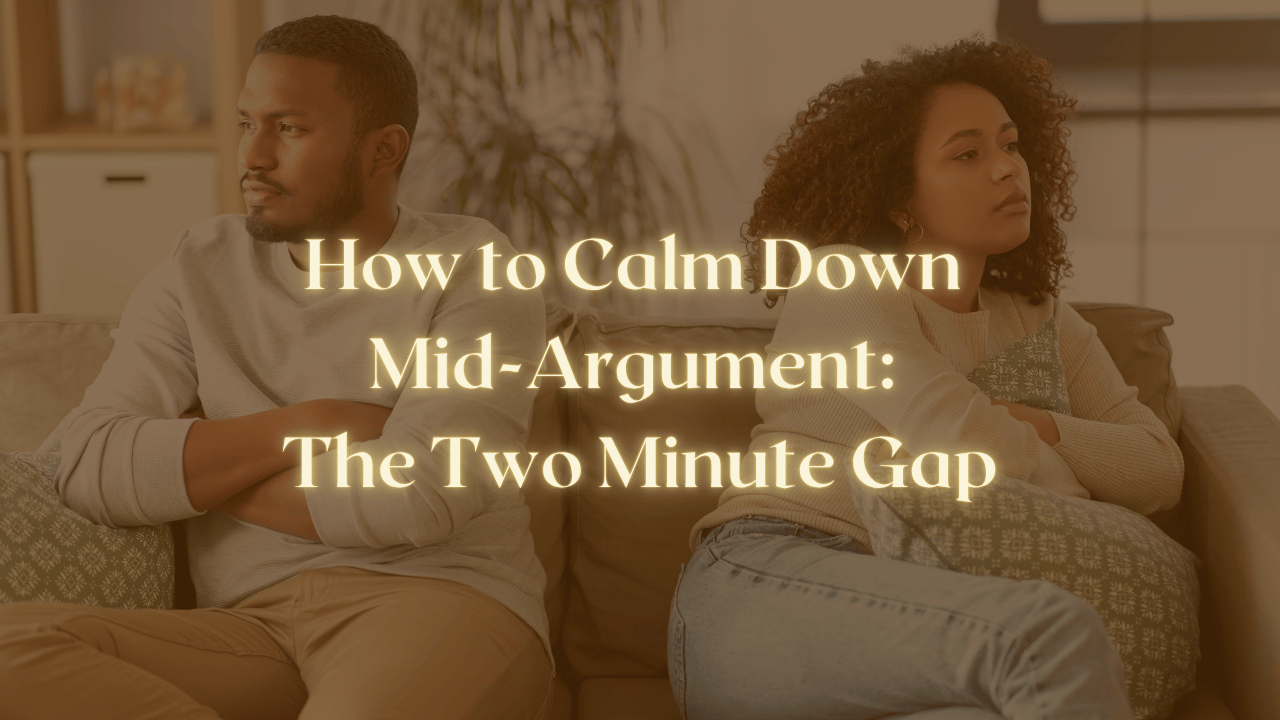
There is a moment in a difficult conversation, usually early, when you feel the temperature go up a degree in your chest. Nothing has been shouted. But something has shifted, and you can already hear the sentence you are about to say, fully formed, waiting.
That sentence is not yours. It belongs to the temperature.
This is about the two minutes that sit between the two, what happens inside them, and how to reach them when stepping away in the middle of something hard feels impossible.
What you will find here
- What a two minute gap actually does
- Why a small chore works better than sitting still
- The difference between a gap and walking out
- How to reach the gap when it is new
- When you cannot leave the room at all
- Coming back, which is the part that counts
- Frequently asked questions
What a two minute gap actually does
It does not make you calmer in some general sense, and it is not a way of suppressing what you feel. It does something more specific than that.
It makes you the author of your next sentence again.
In the rising moment your body is preparing you for something, and what it is preparing you for is rarely what the conversation needs. The sentence assembling itself is built to win the point, or to smooth the discomfort away, or simply to make the feeling stop. None of those is the same as being heard, and the difference between them usually decides whether the conversation goes anywhere. Often the heat is not really about this conversation either, but about everything you absorbed quietly before it, which is why the small thing was never the small thing.
There is a second saving that arrives later. The sentence said at the wrong temperature does not end when the conversation ends. It follows you into the evening, gets replayed at eleven at night, gets rewritten four times before morning. Most of us count the cost of a hard conversation in the twenty minutes it took. The larger invoice is the hours afterwards spent re-examining one sentence you wish you had said differently.
Two minutes taken at the right moment is the cheapest trade available.
Why a small chore works better than sitting still
The instruction people are usually given is to pause and breathe. That works for some, and for many it does not, because sitting still with a racing system often just gives the racing more room.
A small physical task tends to work better, and for a reason worth understanding.
A chore is ordinary. It has a beginning and an end and it finishes inside two minutes, which almost nothing in an argument does. Your hands have something to do, which occupies the part of you that wants to act. And doing one plain thing well places the conflict next to something plain. Next to something plain, it shrinks to its real proportions.
That is the thing most worth naming. You do not come back having decided the situation does not matter. You come back knowing its actual size, in your day and in your head, rather than the size it had when it was filling the whole room.
Wash the two things in the sink. Put the laundry in. Water something. Carry the thing that has been in the hallway for a week to where it belongs. Two minutes, hands busy, finished.
The difference between a gap and walking out
From the outside these can look identical, and only one of them helps.
A gap has the return built into it. That is its whole definition. You are not withdrawing from the conversation, you are declining to have it at the wrong temperature, and then you come back and have it.
Leaving to punish someone is not a gap. Leaving so that they will follow you is not a gap. And leaving, then handling everything afterwards by going quiet inside the relationship for weeks, is not a gap either. That is a door with no clock on it, and it costs far more than the original conversation would have.
If the room is one where you can say it, say it. "Give me two minutes." Four words, no explanation owed. If you cannot say it in that particular room, leave anyway and come back, because the returning is what makes it readable as a pause rather than an exit.
It is also worth knowing the difference between a conversation that needs a gap and a pattern that needs something larger. A rising moment in a relationship that repairs afterwards is ordinary human friction. If the same conversation happens on a loop with no repair, that is a different question altogether, and no amount of good pausing on your side will resolve it alone.
How to reach the gap when it is new
Here is the honest difficulty, and it is the reason most advice about staying calm fails.
The moment you most need the gap is the moment you have the least capacity to invent one. You cannot design an exit while the temperature is climbing, in the same way you cannot work out what your body is telling you while you are busy defending yourself. Anything that requires a decision in that second will not be there when the second arrives.
So it has to be chosen in advance, on an ordinary day, when nothing is at stake.
Pick one thing. Only one. A menu is another decision, and decisions are exactly what you will not have. Choose the chore, or the song, or the bathroom, and let that be the one your body reaches for every time until it stops needing to be chosen.
Then give yourself the permission, which for most sensitive people is the harder half. You are allowed to leave a conversation for two minutes. You do not owe anyone continuous availability at whatever temperature they happen to be running. If you have ever needed to step out at a gathering, you already know your body asks long before your manners allow it.
It will be clumsy at first. You will leave too late, or come back still hot, or stand in the kitchen having forgotten why you went in. That is not failing at it. That is the route being laid down, and the route is the whole point, because eventually your body takes it without asking you.
If choosing that one thing in advance is where you get stuck, that is what I made The Gentle Return Ritual for, a $12 practice built around the coming back rather than the leaving. It is short and it is the same every time, and having it decided already is most of what makes it reachable on a hard day.
When you cannot leave the room at all
Sometimes standing up is not available. You are driving, or in a meeting you cannot exit, or at a table where getting up would be an event in itself.
The same principle works at a smaller scale. You are still going to the same place, which is back to yourself.
- Something physical and private. Pressing your thumb and your little finger together, hard enough to have something to feel that is not the conversation. Feet flat on the floor, letting the ground take your weight for a moment.
- A song you know all the way through, so your attention has somewhere to stand that is not the next sentence.
- One longer exhale, longer than the breath in. Not a breathing exercise, just one, unnoticeable to anyone else. If you want something more structured for the harder moments, there is a simple three minute grounding practice that works well as your calm-day choice.
- A sentence that buys time in the room. "Let me think about that for a moment." "I want to answer that properly, give me a second." Both are true, both are ordinary, and both create the gap without leaving the chair.
If the difficult conversations in your life come with someone regularly directing their frustration at you, the gap is necessary but it is not the whole answer, and it is worth reading about how to answer that kind of pressure without either anger or surrender.
Coming back, which is the part that counts
The gap is only half of it. Anyone can leave. The practice is in what you do when you walk back in.
You return and resume, at the point where it was, without a speech about having needed a moment and without punishing anyone for the two minutes. And ideally you return without the two postures that put the temperature up in the first place: no need to convince, and no need to please.
Those two are worth sitting with, because most of us have a preferred one. Some of us come back still building the case. Some of us come back over-smoothing, apologising for the pause, working to make everything comfortable again. Both are the same move in different clothes, and both hand the conversation back to whoever is loudest.
The version that works is plainer than either. You come back, you say the true thing at a temperature that can be heard, and you let it land however it lands.
All of these small practices, the chore, the song, the pressed fingers, the longer exhale, do exactly one thing, and it is the same thing every time: coming back to yourself, so that you can calmly reopen to the world.
One note of care before the questions. If a conversation regularly leaves you frightened rather than frustrated, or if the rising happens with a force that does not settle afterwards, that deserves talking through with a professional you trust rather than sorting alone. Gentle practices sit alongside that kind of support rather than replacing it.
Frequently asked questions
How do I calm down in the middle of an argument?
Leave for two minutes and come back. Do something ordinary with your hands, then resume the conversation. The aim is not to feel nothing, it is to stop the sentence that the heat wrote from being the sentence you say.
Is walking away during an argument a bad thing?
It depends entirely on whether you return. A short pause with a return in it lowers the temperature for both people. Leaving without coming back, or going quiet for days afterwards, is a different thing and it does real damage.
How long should the pause be?
Two or three minutes is usually enough, and short is part of why it works. Long enough for your system to come down, short enough that the other person does not experience it as abandonment.
What do I say before I step away?
"Give me two minutes" is enough. No explanation is owed. If saying even that feels impossible in the moment, go and come back, and the returning will speak for itself.
Why does a chore work better than breathing?
Because it occupies your hands and it finishes. Sitting still with a racing system can give the racing more room, while an ordinary completable task gives your body something to do and puts the conflict next to something plain, which is what shrinks it back to its real size.
What if I cannot leave the room?
Use a smaller version. Pressed fingers, feet flat on the floor, one longer exhale, a song running underneath. Or a sentence that buys time in the room, such as "let me think about that for a moment."
What if the pause makes the other person angrier?
Some people do escalate when you step out, and that is information worth noticing rather than a reason to stop. A short pause that is announced and returned from is a reasonable thing to ask for. Someone who cannot tolerate two minutes is telling you something about the conversation.
Is this the same as the silent treatment?
No, and the difference is the clock. A pause has a return time. The silent treatment is an open-ended withdrawal used to make someone feel your absence. One lowers the temperature, the other raises it while looking calm.
Why do I only think of the right response afterwards?
Because in the moment your attention is occupied with managing the heat. The clarity arrives once the demand drops, which is exactly what a gap creates deliberately instead of waiting for the drive home to provide it.
How do I stop replaying the conversation all evening?
Mostly by having said something you can stand behind, which is what the gap buys you. When the replaying still happens, treat it as residue rather than as unfinished business, and give your body something ordinary to do rather than giving your mind another rehearsal.
Does this work in a work meeting?
Yes, and the mechanics are the same. The bathroom is the exit most workplaces sanction without question, and "let me come back to you on that" is the sentence version. Both buy the same ninety seconds.
How long before this becomes automatic?
Longer than you would like, and it does happen. Choosing one method and repeating it is what builds the route. Eventually the body takes it before you have decided anything, which is what you are actually training for.
What if I always leave too late?
Then move your marker earlier. Most people wait for anger and the useful signal is well before that: the chest warming, the jaw setting, the sentence arriving fully formed. Leaving at the sentence rather than at the anger is the adjustment.
Can this be part of a daily practice rather than an emergency measure?
It works far better that way. Small pauses built into ordinary days give your body the route in advance, so it is already familiar when a hard moment arrives. There are several gentle rituals that serve this purpose well.
A gentle close
The composure you admire in other people is rarely a matter of feeling less. Often it is a matter of being briefly, deliberately absent at the right moment, and then returning on purpose.
Two minutes. Something ordinary. And the whole thing put back in its proper place.
If your inner world tends to be loud enough that finding the gap is hard, Quieting the Noise is a gentle workbook for sensitive minds, with practices for coming back to yourself when a room has filled up: https://www.theritualistmethod.com/quieting-the-noise-lm
Satine is the founder of The Ritualist Method, a gentle, sensory framework of breath, reflection, and daily ritual created for highly sensitive people. A yoga instructor since 2010, she brings more than fifteen years of guiding the body toward steadiness, along with her own seasons of moving through overwhelm, to help sensitive souls feel calmer in the body and return to their own rhythm. She writes and guides not as an expert standing above, but as a Light Keeper who found her own way home.