Sensory Overload: What It Is, Why It Happens, and How to Come Back Down
Aug 09, 2026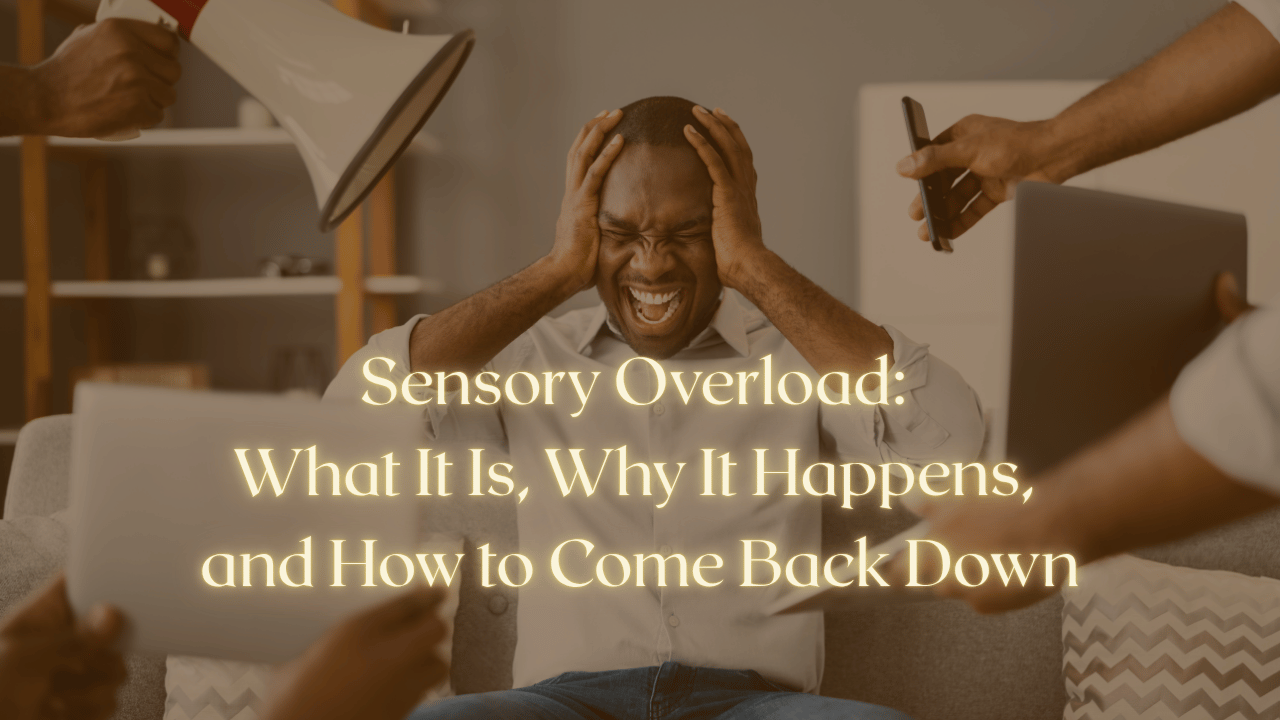
Sensory overload is what happens when the amount of information coming in exceeds your nervous system's capacity to process it. The lights, the noise, the conversation, the phone, the smell from the kitchen, the person needing something from you, all arriving at once and none of it getting filed. Your system stops coping, and you feel it as a rising panic, a need to escape, a sudden inability to think, or an urge to snap at whoever is nearest.
It is not weakness and it is not an overreaction. It is a threshold being crossed. And thresholds can be worked with, which is the whole point of this page.
If you have ever stood in a supermarket unable to choose between two identical things, or left a party feeling as though you had been assaulted by it, or shouted at someone you love because the television was on and the kettle was going and one more sound would have finished you, you already know what this is. What you may not know is what is happening underneath it, and what actually helps.
In this guide
- What sensory overload actually is
- What it feels like
- Why it happens to some people more than others
- Common triggers
- What to do during sensory overload
- What to do afterwards
- How to raise your threshold over time
- When it is worth talking to someone
- Frequently asked questions
What sensory overload actually is
Your nervous system is doing something remarkable and invisible all day: filtering. Of the enormous amount of information arriving through your senses at any moment, only a fraction reaches your conscious attention. The rest is sorted, deprioritised, and discarded before you ever notice it.
Sensory overload is what happens when that filtering system is outpaced. Too much arrives too fast, the sorting cannot keep up, and everything begins reaching you at once, undifferentiated and equally urgent.
At that point your body does something sensible and unhelpful. It reads the flood as a threat, because a system overwhelmed by input has historically meant danger, and it engages the stress response. Heart rate rises. Breathing shortens. Attention narrows. You are now, physiologically, in a mild emergency, standing in a shop.
This is why reasoning does not work in the moment. You cannot talk your way out of it, because the part of the brain that does the talking has been demoted. This is also why "just calm down" is such useless advice, and why it makes everything worse when someone says it to you.
What it feels like
- A rising, urgent need to get out, immediately, whatever the social cost.
- Irritability that arrives from nowhere and lands on whoever is closest.
- Sudden inability to make simple decisions, or to follow what someone is saying.
- Sounds becoming unbearable, particularly overlapping ones, or repetitive ones.
- A tight chest, a clenched jaw, shallow breathing, a headache building behind the eyes.
- Wanting to cry without a reason you can point to.
- Going quiet and blank, shutting down rather than escalating.
- Feeling touch as intolerable, including from people you love.
The shutdown version deserves a mention, because it is less recognised. Not everyone escalates. Many people simply go still and switch off, and get told afterwards that they seemed fine. They were not fine. They were gone.
Why it happens to some people more than others
Because the threshold sits at different heights in different people.
If you are a highly sensitive person, your nervous system takes in more detail and processes it more deeply. That is a real advantage in many settings and it means you reach the ceiling sooner. Roughly fifteen to twenty percent of people are wired this way, which is a great many people quietly leaving parties early.
Sensory overload is also common in autistic people and in people with ADHD, where sensory processing differences are well documented. It appears in anxiety, in trauma, and in the aftermath of concussion. And it happens to absolutely everyone when the input is extreme enough. Nobody is immune. The difference is where your ceiling sits.
The ceiling also moves. It is lower when you are tired, hungry, unwell, premenstrual, grieving, or already stressed. This is why the same supermarket is fine on Tuesday and unbearable on Thursday, and why you are not imagining that inconsistency.
Common triggers
Noise is the one people name first, and particularly layered noise: a conversation over music over traffic. Open-plan offices are unusually good at producing exactly this.
But the trigger is rarely a single source. It is accumulation. Fluorescent lighting, a scratchy collar, a phone buzzing, someone talking at you, a decision to make, all of it stacking. Any one of them is manageable. Together they cross the line.
Emotional input counts too, and this is the part people forget. Other people's moods are sensory information. A tense room costs you processing capacity in exactly the way a loud one does. If you absorb other people's feelings, you are running a heavier load before a single light bulb flickers.
Time pressure is a multiplier. Being watched is a multiplier. And a day with no gaps in it means you arrive at the last hour with your capacity already spent.
What to do during sensory overload
The goal in the moment is not to feel better. It is to reduce the input, so your system can catch up. Comfort comes afterwards.
Leave, if you can leave
This is first for a reason. It is not avoidance and it is not rude. Stepping outside, into a corridor, a bathroom, a car, anywhere with less coming in, is the single most effective thing available to you. Five minutes of low input does more than an hour of trying to cope in the middle of it. You are allowed to go.
Cut the channels you can control
You will rarely be able to turn the world down, but you can usually turn something down. Close your eyes. Put your hands over your ears for a moment, which is not childish, it is effective. Ear defenders or headphones if you have them. Sunglasses. Take off the coat, loosen the collar. Every channel you close gives capacity back.
Lengthen your exhale
Breathe in for a count of four, out for a count of six. The longer exhale is one of the fastest levers you have on a stress response, and it works when nothing else is available to you, including in the middle of a meeting where nobody will notice you doing it.
Come back into your body
Overload scatters attention. Grounding gathers it. Feel your feet on the floor. Feel the weight of you in the chair. Name three things you can physically feel right now. This is not a distraction technique, it is a way of giving your attention a single, simple, undemanding task. My Express Grounding audio takes three minutes and asks nothing of you, and this three minute grounding practice does the same in writing.
Do not make decisions
Your judgment is truly impaired during overload. Do not quit, do not send the message, do not have the conversation, do not decide what you think about anything. Everything can wait an hour, and it will look different when it does.
What to do afterwards
Recovery is not optional and it takes longer than people expect. An hour of overload can need a whole evening to settle, and pretending otherwise is how one bad afternoon becomes a bad week.
Give yourself low input on purpose. Dim light. Silence, or one sound rather than several. Warmth. Something heavy over you. A shower, which many people find resets them more effectively than anything else, probably because it removes almost every other channel at once.
Let the feeling move rather than storing it. Walk, stretch, cry if crying is what wants to happen. A discharged emotion does not become tomorrow's fatigue.
And be kind about it afterwards, because the shame spiral costs more than the overload did. You did not fail. Your threshold was reached. Self-compassion is not a consolation prize here, it is regulating, and berating yourself keeps the stress response running long after the supermarket is behind you.
The going over of it afterwards is its own kind of noise, and it tends to start once the room has finally gone quiet. That is what I made Quieting the Noise for, a $13 workbook for the mind that reviews the evening and decides you were too much. It gives that replaying somewhere to land, on a page, instead of looping while you try to sleep.
If the overload has become most days rather than some days, you may be closer to burnout than to a bad afternoon, and that needs rest rather than technique.
How to raise your threshold over time
You cannot rebuild your nervous system into somebody else's. You can, quite reliably, stop starting every day with the tank half empty.
The single biggest lever is the state you are in before the input arrives. A rested, regulated system has a much higher ceiling than a depleted one. This is why the work is mostly done on ordinary days, not in emergencies.
Build in gaps. A day with no space between things guarantees you arrive at the last hour with nothing left. Protect the transitions, particularly the one between work and home, which is the one most people give away. A sensory diet, small regular doses of calming input through the day, keeps you from stacking toward overload in the first place.
Close the day deliberately. An evening routine tells a scanning nervous system that it may stop scanning, and sleep is the largest single input on where tomorrow's ceiling sits.
Use small, repeated practices rather than heroic ones. A ritual returned to daily teaches your body a route back to calm that it can find even when flooded, which is precisely when you cannot think of one. That is why rituals work where willpower does not.
And learn what your particular system needs, because it differs. Some people restore through stillness and others truly need movement, and doing the wrong one leaves you more depleted than before. Knowing your pattern is the difference between a practice that works and a practice you abandon. The archetype quiz will show you which you are.
For the deeper version of all of this, calming an overstimulated nervous system and nervous system regulation go further.
When it is worth talking to someone
Please speak with a doctor or another qualified professional if sensory overload is happening most days, if it is stopping you working or leaving the house, if it began suddenly after an illness or a head injury, or if it comes with persistent anxiety or low mood.
Sensory overload is also a common experience for autistic and ADHD people, and many adults reach middle life without ever having been assessed. If a great deal of this page describes your whole life rather than your hard days, that is worth exploring properly rather than quietly managing forever.
Gentle practices sit alongside proper support. They are not a substitute for it, and needing more than a breathing exercise is not a failure of effort.
Frequently asked questions
What is sensory overload?
It is what happens when incoming sensory information outpaces your nervous system's ability to process it. The filtering breaks down, everything reaches you at once, and your body engages a stress response, which is why it feels urgent and physical rather than merely annoying.
What does sensory overload feel like?
Commonly, an urgent need to escape, sudden irritability, an inability to think or decide, unbearable sound, a tight chest, and sometimes tears. Some people shut down and go blank instead of escalating, which is just as real and far less recognised.
Is sensory overload a panic attack?
They overlap but they are not the same. Sensory overload is driven by too much input; panic is driven by fear, often without an external trigger. Overload can tip into panic, and the same calming tools help both.
Why does noise bother me so much?
Sound is hard to filter out and impossible to close your eyes to, and layered sound is worst of all because each stream must be processed separately. If your threshold is lower than average, noise reaches it first. If sound is the input that overwhelms you most, there is a fuller answer in noise sensitivity, why sounds overwhelm you, and what helps.
Do only autistic people get sensory overload?
No. It is common in autistic people and in people with ADHD, and it is also common in highly sensitive people, in anxiety, in trauma, after concussion, and in absolutely anyone given enough input. The difference is where the threshold sits.
How do I stop sensory overload in the moment?
Reduce the input first, everything else second. Leave the environment if you can, close whatever channels you control, lengthen your exhale, and bring your attention back to your body. Do not try to reason yourself calm, because that part of your brain is not currently available.
How long does it take to recover?
Longer than most people allow. An hour of overload can require an evening of truly low input to settle. Rushing back into stimulation is the most common reason a single bad afternoon turns into a bad week.
Why is it worse some days than others?
Because your threshold moves. Tiredness, hunger, illness, stress, grief, and hormonal changes all lower it. The supermarket did not change. Your available capacity did.
Why do I snap at the people I love during overload?
Because they are nearest, and because a flooded nervous system has very little left for social regulation. It is not a statement about them. It does help to warn them in advance, so it is understood rather than taken personally.
Can sensory overload make you cry?
Yes, and it does not require sadness. Tears are a common release when a system is overwhelmed, and they often arrive with no accompanying emotion you can name, which is confusing but entirely normal.
Does sensory overload get better with age?
The underlying sensitivity tends not to change, but the experience often improves a great deal, because you learn your triggers, protect your recovery, and stop forcing yourself through environments that flood you.
Are noise-cancelling headphones or ear defenders cheating?
No. They are a reasonable adjustment to an environment that was not built for your nervous system, in the same way glasses are a reasonable adjustment to eyesight. Use them and let people think what they like.
Can I train myself to handle more?
Not by forcing exposure, which usually raises the stress and lowers the ceiling. What works is arriving at the input better rested and better regulated, so that your threshold starts higher in the first place.
Why do I go blank instead of getting upset?
Shutdown is the other end of the same response. When escalation is not possible or not safe, the system withdraws instead. It looks like coping from the outside, which is why it is so often missed, including by the person it is happening to.
When should I see a doctor about sensory overload?
If it is happening most days, interfering with work or leaving the house, arrived suddenly after illness or head injury, or comes with persistent anxiety or low mood. If it describes your entire life rather than your hard days, an assessment is worth asking for.
A gentle closing
Sensory overload is not a character flaw and it is not an overreaction. It is a threshold, and thresholds are physical facts rather than moral ones. You were not too weak for the supermarket. There was simply more coming in than any system of your particular design could sort.
The work, in the end, is less about enduring the flood and more about not arriving at it already empty. Rest earlier than you think you need to. Leave when you need to leave. Close the day on purpose. And be gentler with yourself afterwards than the world has taught you to be.
If you would like to know which practices actually suit your nervous system, rather than someone else's, the archetype quiz will show you your pattern in a few minutes. And when the noise is mostly the one inside your own head, Quieting the Noise was written for exactly those days, and the easiest door in is the starter version on that page.
With warmth,
Satine, the Ritualist
About the author
Satine is the founder of The Ritualist Method, a gentle, sensory framework of breath, reflection, and daily ritual created for highly sensitive people. A yoga instructor since 2010, she brings more than fifteen years of guiding the body toward steadiness, along with her own seasons of moving through overwhelm, to help sensitive souls feel calmer in the body and return to their own rhythm. She writes and guides not as an expert standing above, but as a Light Keeper who found her own way home.