Why You Keep Organizing Instead of Working (And What Actually Helps)
Jul 28, 2026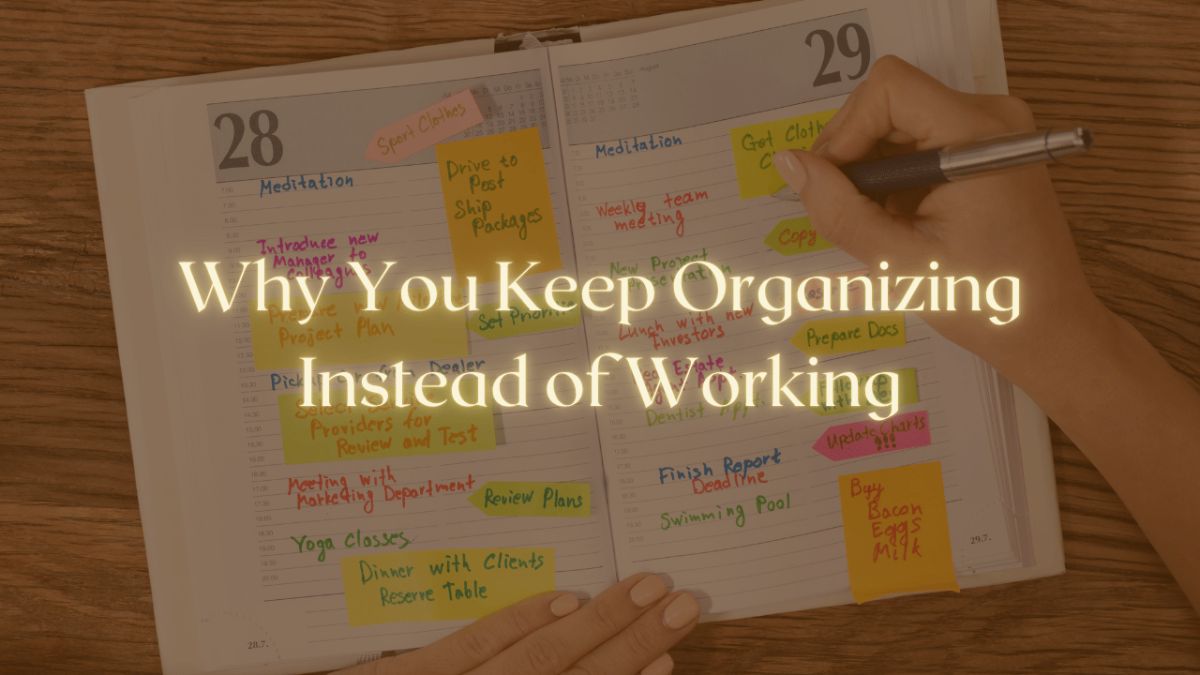
If you keep organizing instead of working, re-planning the planned week, refining the system, migrating the list to a better app, you are not lazy and you are not broken. Over-organizing is productive-looking avoidance: the mind swaps a large, uncertain task for a small, certain one that resembles it, because you cannot fail at reordering a list. It delivers a real but short-lived sense of control, and it usually stands guard in front of a piece of work that feels risky. What helps is not shame. It is naming the pattern kindly, letting it be the brief soothing ritual it actually is, and then touching one small, true piece of the real work.
This is a gentle guide to the over-planning loop: why it happens, what it quietly protects you from, why the soothing itself is legitimate, and how to reach the actual work without turning on yourself.
Table of contents
- What does organizing instead of working look like?
- The control high: why planning feels so good
- What the tidying is standing guard in front of
- In defense of the browse: the soothing is real
- What actually helps: the naming practice
- Frequently asked questions
What does organizing instead of working look like?
It looks responsible. It photographs like productivity. You re-plan a week that was already planned. You reorder the task list, refine the color coding, research a better tool and migrate everything into it. You micro-manage your own workflow like a gardener endlessly rearranging her tools while the garden waits.
And at the end of the hour, nothing that matters has moved. That is the tell. Real preparation shortens the distance to the work. Productive-looking avoidance keeps you standing exactly the same distance away, just with tidier equipment.
The control high: why planning feels so good
An over-organizing session delivers one thing very reliably: a sense of control. Not a lasting one. It fades like a sugar high, sometimes within minutes. But in the moment it is real comfort, and it is worth understanding why.
The real work is large, open-ended, and might not go well. The system is small, closed, and always goes well. You cannot fail at reordering a list. So when the stakes feel big, the mind quietly swaps the uncertain task for a certain one that resembles it. Every refined schedule whispers: see, you are on top of it. And you are, of the schedule. Just not of the life the schedule was for.
Sensitive, conscientious people are especially prone to this swap because we are truly good at systems and truly value preparation. The line between preparing and hiding runs directly through our best qualities, which is why we cross it without noticing. Understanding this as a nervous system seeking safety, rather than a character flaw, is the first step, and it is the same ground covered in feeling safe in your body.
What the tidying is standing guard in front of
The organizing binge is rarely random. It tends to appear at specific moments, often right when momentum is building, and it usually protects you from something particular.
A piece of work that might not match your standards. A decision that closes doors. A message that makes a commitment real. A project that would raise expectations if it went well. The list gets rearranged so the door does not have to be opened. Seen clearly, over-planning is not a productivity problem. It is an emotional strategy, a way of staying near the work without entering it. And you cannot fix an emotional strategy with a better app. If the planning is soothing a fear, the fear is the thing to meet.
In defense of the browse: the soothing is real
Here is what most productivity advice skips: the soothing itself is legitimate.
Think of window shopping. You can spend an afternoon walking past shop windows, imagining, arranging futures in your head, and buying nothing, and it calms something that has little to do with the objects. Organizing your work instead of working is the same walk. You are browsing your own life, arranging futures, purchasing none of them.
And it is not worthless. A nervous system facing something big deserves a way to settle, and there are far worse ways than tidying. Something real can even happen in the browse: many people come out of an organizing session understanding a little better how they want to work next, the way window shopping teaches you your own taste without costing you anything. The problem is never the ritual itself. The problem is when the ritual impersonates progress, and when shame about it adds a second layer of weight. Shame has never once made anyone start the real task sooner. This is the heart of emotional regulation for highly sensitive people: meeting the pattern with honesty instead of self-attack.
What actually helps: the naming practice
1. Catch it and name it, kindly, while it is happening
Mid-reorganization, say the true sentence: I am soothing right now, not working, and that is allowed for a little while. Naming ends the self-deception (the hour can no longer masquerade as progress) and removes the shame (soothing is a real need). A named ritual can be enjoyed and then ended. An unnamed one runs your afternoon.
2. Give the tidying a container
Fifteen minutes with a timer, enjoyed fully, finished when it rings. A contained ritual keeps its benefits, the settling, the small clarity about how you want to work, without swallowing the day.
3. Ask what the tidying is guarding
When the timer ends, one honest question: what am I avoiding, and what is the smallest true piece of it I could touch today? Not the whole task. One paragraph. One message. Ten minutes inside the real thing.
4. Touch the real work once
Contact dissolves more anxiety than any amount of beautiful scheduling, because the fear was never about the list. It was about the door, and the only cure for a door is walking through it once, briefly, today.
5. Watch for the repeat tell
If you are reorganizing a system you already reorganized this week, the system is not the problem. Somewhere nearby there is a door. Go find which one.
Frequently asked questions
Is over-planning a form of procrastination?
Often, yes, and it is the hardest kind to catch because it looks and feels responsible. The test is simple: did the real work move? Preparation shortens the distance to the task. Planning-as-avoidance leaves the distance unchanged, with tidier equipment.
Why do I feel calmer when I organize instead of working?
Because organizing offers a small, controllable world when the real work feels big and uncertain. The calm is a genuine control effect, but it is short-lived, and it does not reduce the anxiety about the actual task. Only contact with the task does that.
Is it bad to enjoy planning and organizing?
Not at all. Planning is a real skill and, held lightly, a legitimate soothing ritual. It becomes a problem only when it impersonates progress or stands guard in front of work you need to enter. Contain it, enjoy it, and then touch the real thing.
How do I stop reorganizing my systems all the time?
Name the pattern while it happens, give it a timed container, then ask what it is protecting you from and touch the smallest piece of that. Repeated system-reorganizing is almost always a signal that some specific task feels risky, and the task, not the system, is where the relief lives.
Why do sensitive people over-organize more?
Deep processing means sensitive people feel the size and stakes of a task vividly, so the pull toward a small controllable world is stronger. The same conscientiousness that makes them excellent at systems makes the hiding place more convincing.
What is the fastest way out of an avoidance spiral?
Ten honest minutes inside the real task. Not finishing it, entering it. One paragraph, one message, one true minute. The anxiety drops on contact, because the fear was about starting, not doing.
A gentle closing
Let the tidying be a ritual when you need one, a short walk past the windows of your own life. And then buy one small thing. Touch the real work once today, briefly and honestly. The list will still be there, beautifully arranged, and for once it will be serving the work instead of protecting you from it.
If you would like company while you practice meeting your patterns gently, the Ritualist Circle is a small, calm room of sensitive people doing exactly that, together.
Satine is the founder of The Ritualist Method, a gentle, sensory framework of breath, reflection, and daily ritual created for highly sensitive people. A yoga instructor since 2010, she brings more than fifteen years of guiding the body toward steadiness, along with her own seasons of moving through overwhelm, to help sensitive souls feel calmer in the body and return to their own rhythm. She writes and guides not as an expert standing above, but as a Light Keeper who found her own way home.