What Is Nervous System Dysregulation? Signs, Causes and Gentle Ways Back
Sep 28, 2026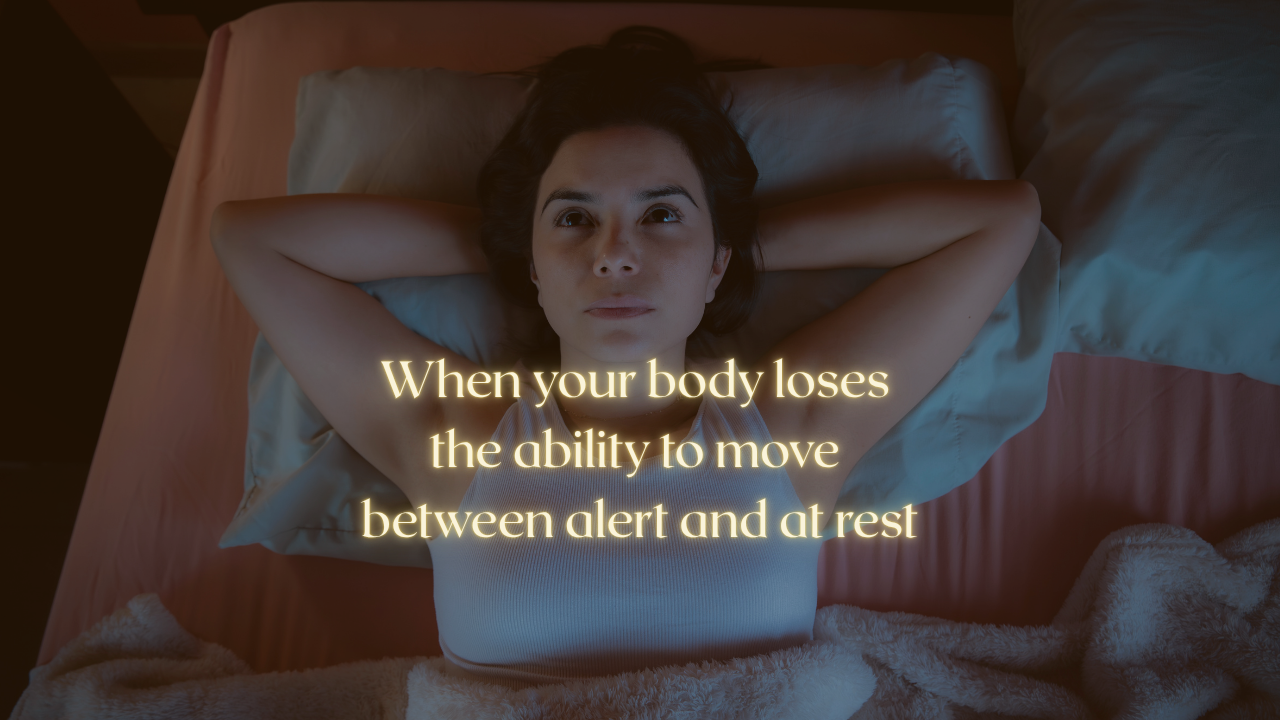
Nervous system dysregulation is what happens when your body loses the ability to move between alert and at rest, and gets stuck at one end. Stuck high, it looks like a racing mind, a tight jaw, sleep that will not come and a temper with a short fuse. Stuck low, it looks like fog, flatness, a tiredness that a weekend does not touch, and a strange distance from your own life. Either way the tell is the same: the state lingers when nothing is currently wrong. Highly sensitive people are especially prone to it, because a system that takes in more reaches its limit sooner and has further to come back. The reassuring part is that regulation is not a personality trait you have or lack. It is a range of motion, and range of motion can be recovered.
This post explains what dysregulation actually is, how to recognise which end you are stuck at, why it is not the same as anxiety or burnout even when it overlaps with both, and what brings a system back, in the next ten minutes and over the next few weeks. It is written for people who feel a great deal and are tired from it. It is not a diagnosis and it does not replace one.
On this page
- What does nervous system dysregulation actually mean?
- What are the signs of a dysregulated nervous system?
- What causes nervous system dysregulation?
- Why are highly sensitive people more prone to it?
- Is dysregulation the same as anxiety or burnout?
- How do you know if you are dysregulated right now? A three-question check
- How do you settle a dysregulated nervous system in the moment?
- What helps over weeks rather than minutes?
- What makes dysregulation worse?
- When does dysregulation need more than a practice?
- Questions people ask
What does nervous system dysregulation actually mean?
A regulated nervous system is not a calm one. That is the first misunderstanding worth clearing, because it makes people aim at the wrong thing. A regulated system is a flexible one. It rises to meet a demand, a hard conversation, a deadline, a child who will not sleep, and then it comes back down when the demand has passed. Up, and back. The whole art is in the return.
Dysregulation is the loss of that return. The system goes up and stays up, or it drops into shutdown and stays there, or it swings between the two without ever passing through the middle where rest lives. The body has stopped believing that the danger has passed, so it keeps running the emergency settings long after the emergency, and sometimes when there was no emergency at all, only a week that never let up.
In the language of the body, the two stuck positions are roughly these. The high position is the fight-or-flight response left switched on: more adrenaline, more vigilance, a faster heart, shallower breath, muscles held ready. The low position is the body's older shutdown response, the one that conserves energy when a threat cannot be fought or fled: slower, heavier, numb, distant. Most people have a home position they tend to get stuck in, and many sensitive people cycle through both in the same day, wired until midnight and flat by lunch.
None of this is a defect. It is a protective system doing its job with information that is out of date. If you want the wider picture of how the system works and what safety feels like from the inside, the beginner's guide to nervous system regulation is the companion to this post. This one is about recognising the stuck state and finding the way out of it.
What are the signs of a dysregulated nervous system?
The signs sort themselves by which end you are stuck at. Read both lists, because it is common to recognise yourself in each on different days.
Stuck high, the activated state. A mind that will not stop running the day back at you. Trouble falling asleep, or waking at three with the engine already on. Irritability that surprises you, snapping at people you love over nothing. A jaw that aches by evening, shoulders up by your ears, breath that lives in the top of the chest. Startling easily. Feeling rushed when nothing is urgent. Difficulty sitting still, and difficulty enjoying the stillness when you finally manage it.
Stuck low, the shutdown state. A fog that makes simple decisions feel enormous. Tiredness that sleep does not repair. Flatness where feelings used to be, including the good ones. Wanting to cancel everything and then feeling worse for having cancelled. A sense of watching your life from slightly behind glass. Losing words, losing the thread of a conversation, losing an hour to the phone without meaning to.
The swing. Some people do not settle in either state. They run high all day on effort and caffeine, collapse into shutdown the moment they stop, and wake up already braced for the next round. Overreacting to something small, then having nothing left for something large, is the signature of the swing.
There is one more sign, and I have come to trust it more than the lists. It is what happens to your judgement. When my own system is dysregulated I still read rooms fast, the way I always have, but the readings go wrong in a particular direction: everyone seems slightly hostile, every pause seems to mean something, every new person seems cold. I have learned that a run of those verdicts is not information about the people. It is information about my state. If your instincts have all started pointing the same way at once, that is often the earliest sign that the system, not the world, has shifted.
What causes nervous system dysregulation?
Rarely one thing. Usually an accumulation with no recovery between the parts.
Load without return. The commonest cause is simply too many activations in a row with no real coming down between them. A demanding job, a caring role, a house move, a season of bad news, each of them survivable alone, stacked without a gap. The system never gets to finish the cycle, so it stops trying to.
Old alarms. A nervous system learns. If it has been through a period, recent or long ago, when staying alert was necessary, it keeps that setting available and reaches for it under strain. Past stress and past trauma do not need to be present in the room to be present in the body.
The body's basics. Poor sleep, skipped meals, too much caffeine, too little daylight and too little movement all lower the threshold at which the system tips. Dysregulation is not only psychological; it is often partly a body that has not been given what it runs on.
Sensory overload. For sensitive people this deserves its own line. Noise, light, crowds, screens, other people's moods, a full day of small inputs that individually mean nothing. The system counts all of it, whether or not you do.
No off switch built in. Many capable people have never had a reliable way of signalling to their body that the day is done. Work arrives on the phone in bed, rest is something they will do when things calm down, and things do not calm down. Without a practised way back, the system has nowhere to go but on.
Why are highly sensitive people more prone to it?
Because the equipment is different, and the difference is not a flaw.
A sensitive nervous system takes in more, notices more, and processes what it notices more deeply. That is the trait, and it is the reason sensitive people are good at reading a room, catching what was almost said, and feeling a piece of music or a kindness all the way through. It is also why the system reaches its limit sooner. More input in means the container fills faster; deeper processing means each input takes longer to finish with. A day that a less sensitive colleague finds full, a sensitive person finds overflowing, and the overflow does not show until later, at the sink or in the dark.
The second reason is recovery. Sensitive people tend to need more of it and to be given less, partly because they are competent and quiet about the cost, and partly because the culture around them treats needing recovery as a weakness to be trained out. So the load is higher and the return is shorter, and the arithmetic goes one way. This is why a sensitive person often cannot relax on command: the system is not being stubborn, it has simply not been given enough of the signals it needs to believe the day is over.
The third reason is subtler. Sensitive people feel their own state intensely, so the experience of being dysregulated becomes another input. The racing heart is noticed, and worried about, and the worry adds to the racing. The fog is noticed, and judged, and the judgement deepens the fog. The way out of that particular loop is not to feel less. It is to learn what the states are, so that noticing one becomes information rather than alarm.
Is dysregulation the same as anxiety or burnout?
They overlap and they are not the same, and the difference changes what helps.
Anxiety is a felt experience with a content: a worry, a fear, a thing that might go wrong. Dysregulation is a state of the body that can exist with or without content. A great deal of what gets called anxiety in sensitive people is a body stuck high, producing thoughts to explain the feeling, rather than thoughts producing the feeling. The test is whether the worry changes subject. If the fear keeps finding new things to attach to, and settles when the body settles, the body is usually the place to work.
Burnout is closer to the low end. It is what prolonged dysregulation looks like when it has gone on long enough to change how you feel about your work and your life. Not every shutdown is burnout, and catching the low state early, before it hardens into that, is one of the best reasons to learn the signs.
The honest limit: this post can help you recognise a state. It cannot tell you whether what you are experiencing is anxiety that needs treatment, depression, a thyroid that needs checking, or something else with a name. If what you read here fits but does not lift with practice over a few weeks, that is worth taking to a professional, and doing so is not a failure of the practice. It is the practice working, because it told you something.
How do you know if you are dysregulated right now? A three-question check
You can tell in about a minute, and the answers matter more than any list of symptoms, because they are about you today.
Where is your breath? Put a hand on your chest and one on your belly and breathe normally. If the top hand moves and the lower one does not, you are breathing the way a body breathes when it is braced. That is the high state, whatever your mind is telling you about how fine you are.
Can you feel your feet? Not think about them. Feel them: the floor, the weight, the temperature. If it takes real effort to get your attention down there, or if your body feels vaguely absent below the neck, that is the low state. Presence in the body is one of the first things shutdown removes.
Has the state outlasted its cause? This is the one that separates dysregulation from an ordinary hard hour. A hard hour ends. If the wired feeling from a meeting is still running at midnight, or the flatness from a difficult weekend is still there on Thursday, the system has stopped returning on its own and needs help to.
Two of the three, and you have your answer. That is not a verdict on you. It is a reading of your state, and a state can be changed, starting in the next ten minutes.
If the high state is the one you know best, the running mind at night, the day replayed, the workbook Quieting the Noise was written for exactly those hours. You can get the first pages here.
How do you settle a dysregulated nervous system in the moment?
The principle first, because it explains why some things work and others do not. A dysregulated system is not waiting to be reasoned with. You cannot think your way down, and trying to is usually more activation. What the body responds to is signals of safety delivered through the body: breath, weight, temperature, sound, rhythm, another person. Small, physical, repeated. The same handful of things, done often, does more than any technique done once.
Lengthen the exhale. Breathe in normally and let the breath out slowly, longer than it came in, through a soft mouth. Four or five times. The long exhale is the fastest signal a body accepts that the emergency is over, and it works whether or not you believe it will.
Put your weight somewhere. Feet flat, or your back against a wall, or lie on the floor. Let the surface take you. A held body is a braced body; a body that has given its weight to something is already halfway down.
Give the senses something real. Cold water on the wrists, a warm cup held in both hands, the smell of something you like, one sound in the room followed with your attention. This is the difference between the state and the story: the senses are always in the present, and the present is nearly always safer than the loop.
Move, then stop. For the high state, a short walk, shaking out the hands, rolling the neck and spine. For the low state, the same, but smaller and slower, because shutdown responds to gentle rhythm and is frightened by effort. Stopping afterwards matters as much as the movement; that is when the system practises coming down.
Hum. A low hum on the exhale, felt in the chest, for a minute. It is slightly absurd and remarkably effective, and it works partly through the long breath and partly through the vibration itself.
Be near a settled person. Nervous systems regulate each other. Ten minutes beside someone calm, without talking about the problem, can do what an hour alone cannot.
My own way back is a small sequence I have done for so long that it comes back to me like a dance: a glass of water drunk slowly, a little movement, the neck and spine stretched, then listening to the sounds around me before I listen to my own breath, a scent, warm hands, a humming breath, and a few minutes with a candle flame. Nine steps sounds like a lot. It takes ten minutes, and on the days I cannot do it all, three of the steps still work, because the body recognises the shape. If you would like something to follow rather than build, a simple body scan is the gentlest place to start.
What helps over weeks rather than minutes?
The ten-minute practices bring you down. They do not, on their own, move the baseline, which is the resting position your system returns to when nothing is asked of it. A baseline that sits too high or too low is what makes the stuck states so easy to fall into, and it moves slowly, through repetition, not through one good day.
Bookends. A short practice at the start of the day and a shorter one at the end, the same each time. The consistency is the medicine; the system learns that there is a reliable door out, and starts to expect it.
Real recovery, scheduled. Not rest when things calm down. Rest on the calendar, before you need it, in units the system can actually use: an evening with nothing in it, a morning without a screen, a day after the gathering left empty on purpose. For sensitive people this is not indulgence. It is maintenance on equipment that runs hot.
The basics, made boring. Sleep at a regular hour, food at regular times, daylight before noon, less caffeine than you think you can handle. These are unglamorous and they do more for the baseline than anything with a name.
Somewhere to put the residue. Dysregulation often lingers because the day's charge has nowhere to go. A page written at night, a walk that ends the workday, a conversation that lets the feeling through. Emotional residue is a real thing, and it is far easier to clear daily than to carry for a month.
A longer settling, when the baseline will not budge. Sometimes the system has been running high for so long that ten minutes a day cannot reach it, and what it needs is a few consecutive days with the same signals repeated until the body believes them. That is what I built the 3 Day Home Retreat for: three guided meditations, one a day, with a soft binaural tone beneath the voice, a somatic ritual that brings you back into the body through the five senses, and a printable guide. It fits around an ordinary week, needs no travel and no arranging, and it is yours to repeat whenever the baseline drifts up again. If three days is not enough, there is a seven day version of the same thing.
What makes dysregulation worse?
Knowing the accelerants matters as much as knowing the brakes, because most of them feel like coping at the time.
Pushing through. Treating the wired state as productivity and the flat state as laziness, and overriding both. The system reads the override as further evidence that it is not safe to stand down.
The screen at the edges of the day. First thing and last thing, the phone hands the nervous system a hundred small inputs when it is most able to be shaped by them. Sensitive people pay more for this than most.
Caffeine as a substitute for recovery. It works, which is the problem. It lends energy the body does not have and adds it to the bill.
All-or-nothing practice. An hour of yoga on Sunday and nothing all week. The baseline responds to frequency, not intensity; five minutes daily beats an hour weekly by a wide margin.
Self-judgement about the state. Being angry at yourself for being wired, or ashamed of being flat, is itself an activation. The kindest and most effective response to noticing a stuck state is a plain, almost bored, "there it is", followed by one of the practices above.
When does dysregulation need more than a practice?
Everything above is for the ordinary version: the system that has been asked to carry too much and has forgotten how to come down. It is not for everything. If the state is constant across calm weeks as well as hard ones, if it is shadowed by fear or hopelessness that does not lift when the circumstances change, if it is stopping you from sleeping, eating, working or being with the people you love, then it may be more than a body that needs settling, and a professional you trust is the right next step rather than one more technique.
The line to watch is duration and function, not intensity. Sensitive people feel their states intensely; that is not a symptom. A state that persists regardless of circumstances and stops your life from working is worth exploring with someone qualified, and being sensitive does not disqualify you from also having something that deserves proper support. Many people find the two easier to tell apart once each has been named, and a good clinician will not ask you to stop being sensitive in order to be helped.
Questions people ask
What does a dysregulated nervous system feel like?
Either wired or flat, and unable to shift. The wired version feels like a mind that will not stop, a body that will not settle and a fuse that has shortened. The flat version feels like fog, heaviness, distance and a tiredness sleep does not fix. The common thread is that the feeling outlasts whatever caused it.
How do I know if my nervous system is dysregulated?
Run the three-question check above: where is your breath, can you feel your feet, and has the state outlasted its cause. Two out of three is a reasonable sign. A run of fast negative readings about other people is another early tell, because a stuck system colours what you see.
Can a dysregulated nervous system heal?
Yes. Regulation is a range of motion, and range of motion is recovered through repetition: small physical signals of safety, given often, until the return becomes reliable again. Most people notice the in-the-moment practices working within days and the baseline shifting over weeks. Where the cause is older or heavier, that work is best done alongside a professional.
How long does it take to regulate your nervous system?
Minutes for the state and weeks for the baseline. A long exhale can bring the body down noticeably within a few breaths. Changing where the body rests by default takes consistent daily practice, usually a few weeks before it feels different and longer before it feels stable.
What is the fastest way to calm a dysregulated nervous system?
Lengthen the exhale and give your weight to something solid. Those two together, for two minutes, are the fastest reliable pair. Cold water on the wrists or face is the fastest single sensory signal for the high state.
What are the signs of nervous system dysregulation in highly sensitive people?
The same signs as anyone else, arriving sooner and lingering longer: overwhelm after ordinary social days, sleep that fails after a full day of input, tears or temper that surprise you, and a need to withdraw that others read as rejection. Sensitive people also tend to notice their own state intensely, which can feed the loop.
Is nervous system dysregulation a real diagnosis?
It is a description of a state, not a formal diagnosis. It is a useful description because it points at the body rather than at your character, and because it suggests what to do. It does not replace assessment for anxiety, depression, trauma or physical conditions that can look similar.
Can nervous system dysregulation cause physical symptoms?
Commonly, yes: muscle tension, headaches, digestive trouble, a racing or pounding heart, shallow breathing, fatigue, and disturbed sleep. Any persistent physical symptom deserves a medical check as well, because the body does not label its signals.
Why do I feel dysregulated for no reason?
There is usually a reason; it is just not in the room. Accumulated load, an old alarm being triggered, a sensory day that crossed the threshold, or the body's basics slipping can all produce a state with no obvious trigger. The absence of a reason is one of the clearest signs that the body, rather than the situation, is where the work is.
What is the difference between dysregulation and anxiety?
Anxiety has a content, a thing you are afraid of. Dysregulation is a body state that can produce anxious thoughts to explain itself. If the worry keeps changing subject and settles when the body settles, treat the body first. If the fear is specific, persistent and unchanged by physical settling, it may need its own care.
Does nervous system dysregulation go away on its own?
Sometimes, when the load lifts and the basics return. Often not, because the stuck state changes behaviour in ways that maintain it: less sleep, more caffeine, more screens, less rest. Giving the system a deliberate way back is more reliable than waiting.
What should I do when I notice I am dysregulated?
Name it plainly, without judgement. Then choose one physical signal: the long exhale, the feet, the cold water, the hum. Do it for two minutes before deciding anything else. If you are stuck low, make it gentler and slower than feels necessary. Then, if you can, protect the next hour from further input.
Can grounding techniques help with dysregulation?
They are among the most effective in-the-moment tools, because grounding is exactly the signal a stuck system is missing: the present, through the senses, through weight. Feet on the floor, five things you can see, one thing you can hear, are all grounding. They work best repeated daily rather than saved for emergencies.
Is being highly sensitive the same as having a dysregulated nervous system?
No. Sensitivity is a trait, a system that takes in more. Dysregulation is a state, a system that is stuck. Sensitive people are more prone to the state because of the trait, but a sensitive system can be beautifully regulated, and that combination, depth with a reliable return, is the whole aim.
A gentle close
A dysregulated nervous system is not a broken one. It is a responsive one that has been carrying too much for too long and has lost, for now, the way back. The way back is not a mystery and it is not a personality change. It is a handful of small physical signals, given often, until the body believes them again.
If your system needs more than ten minutes a day to find that return, the 3 Day Home Retreat is three days at home, with headphones on, built for exactly this. And if you would like to know how your own system fills and drains, the archetype quiz is a soft mirror and takes a couple of minutes.
Satine is the founder of The Ritualist Method, a gentle, sensory framework of breath, reflection, and daily ritual created for highly sensitive people. A yoga instructor since 2010, she brings more than fifteen years of guiding the body toward steadiness, along with her own seasons of moving through overwhelm, to help sensitive souls feel calmer in the body and return to their own rhythm. She writes and guides not as an expert standing above, but as a Light Keeper who found her own way home.